ORIGINAL RESEARCH
Optimizing Proof-of-Work for Secure Health Data Blockchain Using Compute Unified Device Architecture
Seid Mehammed 
Department of Computer Science, Institute of Technology, Woldia University, Woldia, Ethiopia
Keywords: Bitcoin, blockchain, graphics processing unit, GPU, healthcare, Proof-of-Work, PoW, secure health data, throughput
Abstract
We present a graphics processing unit (GPU)-accelerated Proof-of-Work (PoW) blockchain design tailored for secure healthcare data management. Our Compute Unified Device Architecture (CUDA)-optimized PoW achieves throughput improvements of approximately 5× to 100× and reduces block-formation latency compared to Central Processing Unit (CPU) mining, making blockchain practical for high-volume health records. We benchmark against standard platforms—Bitcoin, known for its robust security but slow block times; Ethereum (legacy PoW), widely adopted yet less efficient; and Hyperledger Fabric, a permissioned enterprise framework—to quantify performance gains. Empirical tests show GPU-Advanced Encryption Standard in Counter Mode (AES-CTR) processes large health-record payloads in under one second, while our PoW mining throughput improves by approximately 5×, to 100× relative to unaccelerated baselines. We also evaluate end-to-end encryption latency and discuss privacy trade-offs, including that lightweight Advanced Encryption Standard (AES) yields minimal delay, whereas fully homomorphic methods, although privacy-preserving, remain impractical for real-time permissionless blockchains and are not included in our design. We explicitly address regulatory compliance: personal health data are stored off-chain (e.g., Interplanetary File System [IPFS]), preserving the “right to erasure” via deletion of off-chain records, and we implement strict access controls to meet Health Insurance Portability and Accountability Act (HIPAA) security rules. The design includes validator selection rules that limit Sybil attacks by requiring costly work (or stake) and supports post-quantum cryptographic agility (e.g., Falcon signatures). We define our research question (“Can CUDA-accelerated PoW enable a high-performance yet compliant health data blockchain?”) and hypothesize that GPU parallelism will yield substantial increases in speed. Results confirm our hypothesis: throughput and latency are significantly improved while preserving data privacy and compliance. This work makes a comprehensive contribution by detailing implementation methods, performance benchmarking, and analysis of security and legal requirements in a unified blockchain framework for healthcare.
Plain Language Summary
This research examines how blockchain, a secure digital ledger, can be improved for managing healthcare records. Traditional blockchains such as Bitcoin are too slow to handle the large amounts of medical data. We developed a faster system that uses special computer hardware to speed up the process of adding data to the blockchain. Tests show it can process hundreds of medical records per second, making it a practical application for hospitals and clinics. To protect patient privacy, sensitive information is stored securely outside the blockchain, while only coded references are kept on it. This approach ensures that data can be deleted if needed under privacy laws like GDPR, while still meeting HIPAA rules for health data security. Overall, our design shows that blockchain can be both fast and legally compliant, offering a safe and efficient way to manage electronic health records.
Citation: Blockchain in Healthcare Today 2025, 8: 421.
Copyright: © 2025 This is an open-access article distributed in accordance with the Creative Commons Attribution Non-Commercial (CC BY-NC 4.0) license, which permits others to distribute, adapt, enhance this work non-commercially and license their derivative works on different terms, provided the original work is properly cited and the use is non-commercial. See: http://creativecommons.org/licenses/by-nc/4.0. The author of this article own the copyright.
Submitted: June 29, 2025; Accepted: August 21, 2025; Published: September 29, 2025
Corresponding Author: Seid Mehammed, seidmda@gmail.com
Competing interests and funding: The author declares no competing interests.
This research did not receive any specific grant from funding agencies in the public, commercial, or not-for-profit sectors.
Blockchain’s immutability and decentralization promise to improve healthcare record security and interoperability.1,2,3 In practice, however, traditional proof-of-work (PoW) consensus (as in Bitcoin) is slow and energy-intensive. In healthcare settings, high transaction volumes and strict privacy regulations (General Data Protection Regulation [GDPR] and Health Insurance Portability and Accountability Act [HIPAA]) pose additional challenges: patient data must be securely stored and shared, yet blockchains are immutable. We ask: Can a CUDA (Compute Unified Device Architecture)-accelerated PoW design achieve high throughput for a health data blockchain while ensuring privacy compliance? We hypothesize that graphics processing unit (GPU) parallelism can drastically speed up the required cryptographic computations.
Recent studies highlight these issues. For example, GDPR and HIPAA “demand strict protections for private patient data”4,5; and most blockchain systems struggle to reconcile immutability with the “right to be forgotten.”6,7–12 Concurrently, GPU acceleration significantly reduces encryption time.13–16 Building on these insights, our work introduces a tailored GPU-enabled blockchain specifically for healthcare records. Contributions include: (1) a detailed architecture of a CUDA-optimized PoW blockchain; (2) an experimental protocol and benchmarks comparing our system to Bitcoin Secure Hash Algorithm (SHA-256 PoW),17 Ethereum (legacy Ethash PoW)18,19 and Hyperledger Fabric (permissioned Practical Byzantine Fault Tolerance (PBFT) frameworks,20–23 (3) measurements of encryption latency and analysis of privacy trade-offs, (4) compliance strategies for GDPR/HIPAA (e.g., off-chain storage and data deletion); and (5) discussion of validator selection, Sybil resistance, and quantum-security measures.
Related Work and Background
Healthcare Blockchain Requirements
Blockchain applications in healthcare must safeguard electronic health records (EHRs)24 and personal health information (PHI) while enabling authorized and traceable data sharing. Regulatory frameworks such as HIPAA require that medical data be transmitted and stored in a “very secure form”1, while the GDPR emphasizes patient consent, data minimization, and the “right to be forgotten”2,4 Prior studies consistently show that privacy and regulatory compliance are the most critical design requirements for blockchain systems in healthcare.3,25
To meet these requirements, many solutions adopt an off-chain storage architecture: the actual medical content—whether structured EHR fields or imaging files—is stored externally (e.g., in Interplanetary File System [IPFS]), while only encrypted hashes or reference pointers are maintained on-chain.26,27 This allows sensitive patient data to be removed from off-chain storage when consent is revoked. Consent status is tracked via smart contracts, and access control keys are revoked when patients withdraw consent. Off-chain data are unpinned from IPFS, ensuring they become inaccessible. Thereby supporting GDPR-aligned data erasure without compromising blockchain immutability.
Our system follows this design pattern, supporting structured formats such as Health Level 7 standards, Fast Healthcare Interoperability Resource (HL7 FHIR) for EHRs and Digital Imaging and Communications in Medicine (DICOM) for medical imaging. These data formats are encrypted using Advanced Encryption Standard-Counter Mode (AES-CTR) before being uploaded to off-chain storage, ensuring compliance with both HIPAA’s technical safeguards and GDPR’s deletion rights.
Consensus Mechanisms and GPU Acceleration
Bitcoin-style Proof of Work (PoW) has strong Sybil resistance because attackers need majority hash power. However, PoW is slow (Bitcoin’s 10-min block time). Permissioned blockchains such as Hyperledger Fabric achieve high throughput using consensus protocols like PBFT and Read, Act, File, Trash (RAFT).20,28 These models are well-suited for healthcare settings where node identities can be controlled. For example, prior work17,22 explores Fabric’s suitability for secure electronic EHRs, while others18,29,30 focus on improving transaction efficiency in clinical data sharing. Additionally, studies23,31 analyze scalability and performance metrics under healthcare-specific loads.
Modern GPUs are well-suited for parallel number-crunching, making them ideal for accelerating cryptographic operations. Several studies show that GPU-based AES encryption significantly outperforms Central Processing Unit (CPU)-based implementations, particularly for large healthcare datasets.13,14 For instance, Yang et al. demonstrated sub-second AES encryption of a 1.2 GB file using an RTX GPU.15 In our system, we adopt the AES-CTR mode and employ a hybrid Central Processing Unit and a Graphics Processing Unit (CPU–GPU) workflow to encrypt medical record blocks efficiently.
While fully homomorphic encryption (FHE) offers superior privacy guarantees, it remains impractically slow in decentralized environments. A recent systematization of knowledge (SoK) analysis confirmed that FHE introduces prohibitive latency, making it infeasible for permissionless blockchain systems such as Ethereum.32,33 As a result, our architecture opts for symmetric encryption combined with access controls (e.g. multi-party key shares), offering a practical trade-off between performance and privacy.34
Regulatory Context
Regulations such as the GDPR and HIPAA grant individuals specific rights—such as the right to data erasure and strict privacy protections—that appear to conflict with the immutable nature of blockchain ledgers. Several studies proposed technical solutions to this challenge, including the use of redactable blockchains or off-chain data storage mechanisms.2,4,5,24 In our design, we store sensitive medical data off-chain using systems such as IPFS and retain only encrypted hashes and reference pointers on-chain. This approach allows for data deletion at the off-chain layer, effectively fulfilling the GDPR’s “right to be forgotten.”
To meet HIPAA’s technical safeguard requirements, we implement access control through public-key cryptography and smart contracts. This ensures that only authorized users can retrieve or decrypt records, thus enforcing confidentiality, auditability, and controlled data access.35–39
Quantum Resilience and Selection
Conventional blockchains typically rely on cryptographic primitives such as SHA-256 for hashing and elliptic curve cryptography (ECC), like secp256k1, for digital signatures. However, both are susceptible to quantum attacks—most notably Grover’s algorithm, which can significantly reduce the security margin of SHA-256 by halving its effective complexity.4,40 To address this, our design incorporates future-proofing measures, including the planned integration of post-quantum cryptographic schemes such as Falcon, which has demonstrated efficient signature generation and verification in prototype implementations.41–43
Additionally, our framework can be adapted to use SHA-3 or lattice-based PoW algorithms, both of which are more resistant to quantum computing threats.44–46 Validator selection remains based on a PoW lottery mechanism, where participation requires demonstrable computational effort—effectively mitigating Sybil attacks by ensuring that fake nodes cannot gain an advantage without substantial hardware resources.47,48
Importantly, modern GPUs are not only central to accelerating traditional hashing but can be repurposed to support next-generation quantum-resistant cryptographic operations, thus preserving system performance under emerging security standards.49,50
Homomorphic Encryption and Privacy Measures
Although homomorphic encryption (HE) offers strong privacy guarantees, its computational cost makes it unsuitable for real-time applications on public blockchains. Our system prioritizes symmetric encryption (AES-CTR) and multi-party key sharing for efficient privacy protection. The HE is discussed to contrast its theoretical advantages with practical limitations. We also introduce audit logging and consent enforcement using smart contracts, enabling GDPR-compliant data erasure and HIPAA-aligned access control.
Related Blockchain Healthcare Implementations
Notable prior efforts include HE, which integrates Ethereum smart contracts with existing EHR systems to provide decentralized patient control.51
Hyperledger Fabric has been adopted in several health information technology projects due to its modular design and permissioned model.23 Our contribution differs in its focus on public, permissionless blockchain with performance enhancements via CUDA. Unlike MedRec and Fabric, we demonstrate GPU-accelerated block creation and encryption tailored for healthcare workloads, providing a new direction for decentralized, compliant, and high-performance medical data systems.
Methods
Our system implements a PoW blockchain where each block contains encrypted medical data payloads. The high-level protocol is that new records are encrypted with AES-CTR under a shared-key scheme, then broadcast to miners. Miners (CUDA threads) compute hashes (SHA-256 PoW) in parallel across multiple nonces. When a hash meets the target difficulty, the miner broadcasts the block, which includes the block header (hash, previous hash, timestamp) and the encrypted data segments (storing encrypted EMRs or pointers to IPFS data). We employed NVIDIA CUDA on a Ray Tracing Texel eXtreme (RTX) GPU; the AES-CTR encryption and hashing are offloaded to GPU kernels, while a CPU orchestrates I/O and networking.
System Architecture
Figure 1 illustrates the system architecture for the CUDA-accelerated blockchain: healthcare data are encrypted via GPU-accelerated AES-CTR, recorded in the blockchain core through PoW mining, stored off-chain using IPFS, and verified by a validator pool. The compliance layer ensures GDPR and HIPAA alignment.
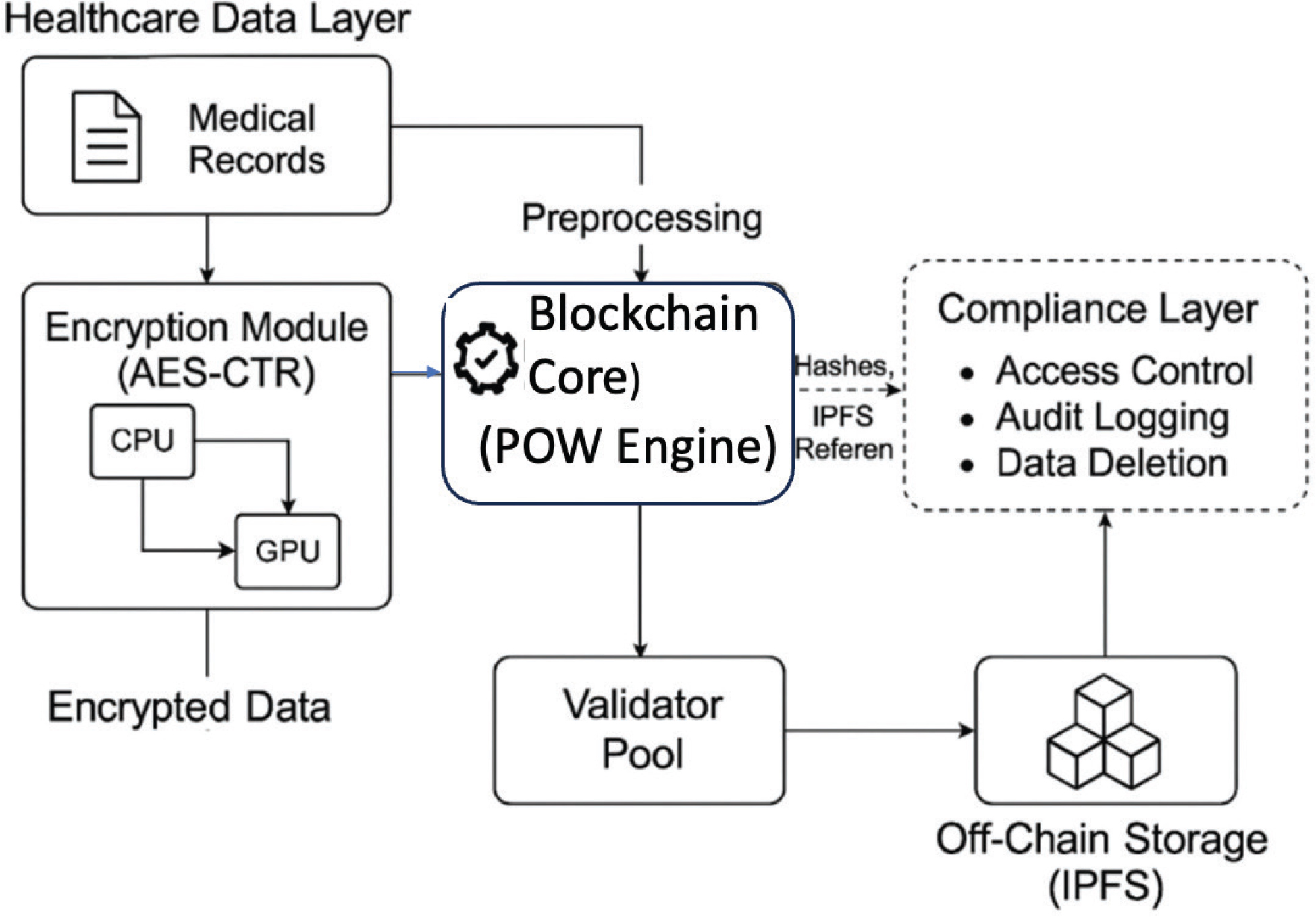
Fig. 1. The high-level architecture of our CUDA-accelerated healthcare blockchain system. CUDA: Compute Unified Device Architecture; CPU: IPFS: Byzantine Fault Tolerance, File System, GPU: graphics processing unit, POW: proof of work.
This architecture ensures high throughput, privacy protection, and regulatory compliance while leveraging the parallelism of GPUs to address PoW bottlenecks (Table 1).
Experimental Setup
We implemented AES-256 in CTR mode using CUDA-C, leveraging the massive parallelism for both encryption and hash computations. A hybrid CPU–GPU workflow dynamically distributes tasks: smaller record chunks are handled by the CPU, whereas bulk encryption/hashing is batched on the GPU. This design follows the model in15,52: GPUs excel for large data (sub-second encryption of ~1 GB), reducing the latency of encryption significantly.
Benchmarks
We evaluated performance on an NVIDIA RTX 3080 GPU (CUDA cores for hashing) and an 8-core Intel CPU baseline. We measured: (1) Throughput – transactions per second (TPS) processed (including encryption and mining); (2) Block latency – time from block proposal to confirmation; (3) Encryption overhead – time to encrypt fixed-size health records. For comparison, we also considered published metrics of other systems53,54: Bitcoin’s block time (~600 s), Ethereum’s block time (~15 s, pre-PoS), and Hyperledger Fabric throughput (tens to hundreds TPS under Caliper testing). We used Hyperledger Caliper23,51,55–58 to simulate baseline Fabric throughput and latency. Our health data samples were synthetic but structured like EHR (fields for identifiers, vitals, etc.), encrypted before chain insertion. Privacy parameters (e.g. AES key length) follow HIPAA standards.
Privacy and Compliance Measures
Each record is stored as (H1(data) || IPFS_ref), where H1 is the hash of the encrypted data and IPFS_ref is a pointer to the off-chain data. Access to the plaintext requires a decryption key shared among authorized providers. To “erase” a record (for GDPR compliance), the off-chain data are deleted; the blockchain entry remains but without accessible content. We also built in audit logging via smart contracts that record data-access events, aiding HIPAA accountability. Validator selection is purely PoW-based: nodes solve the hash puzzle (like Bitcoin) with no additional identity, relying on economic cost for Sybil resistance. We set target difficulty so that on our hardware, the average block time was on the order of seconds (much faster than Bitcoin), to suit healthcare needs.
Performance Chart
Figure 2 illustrates GPU vs. CPU AES-CTR encryption time and also SHA-256 mining throughput for healthcare record sizes (simulated 1 MB–1.2 GB workloads). GPU acceleration yields >90% latency reduction and ~100x higher mining hash rates. Table 2 lists the details related to Figure 2.
| Operation | CPU performance | GPU performance | Speedup (GPU/CPU) |
| AES-CTR encryption | 100 MB/s | 500 MB/s | 5.0× |
| SHA-256 hashing | 50 MH/s | 1000 MH/s | 100× |
| AES-CTR: Advanced Encryption Standard in Counter Mode, CPU: central processing unit, GPU: graphics processing unit, MB: megabyte, SHA: Secure Hash Algorithm. | |||
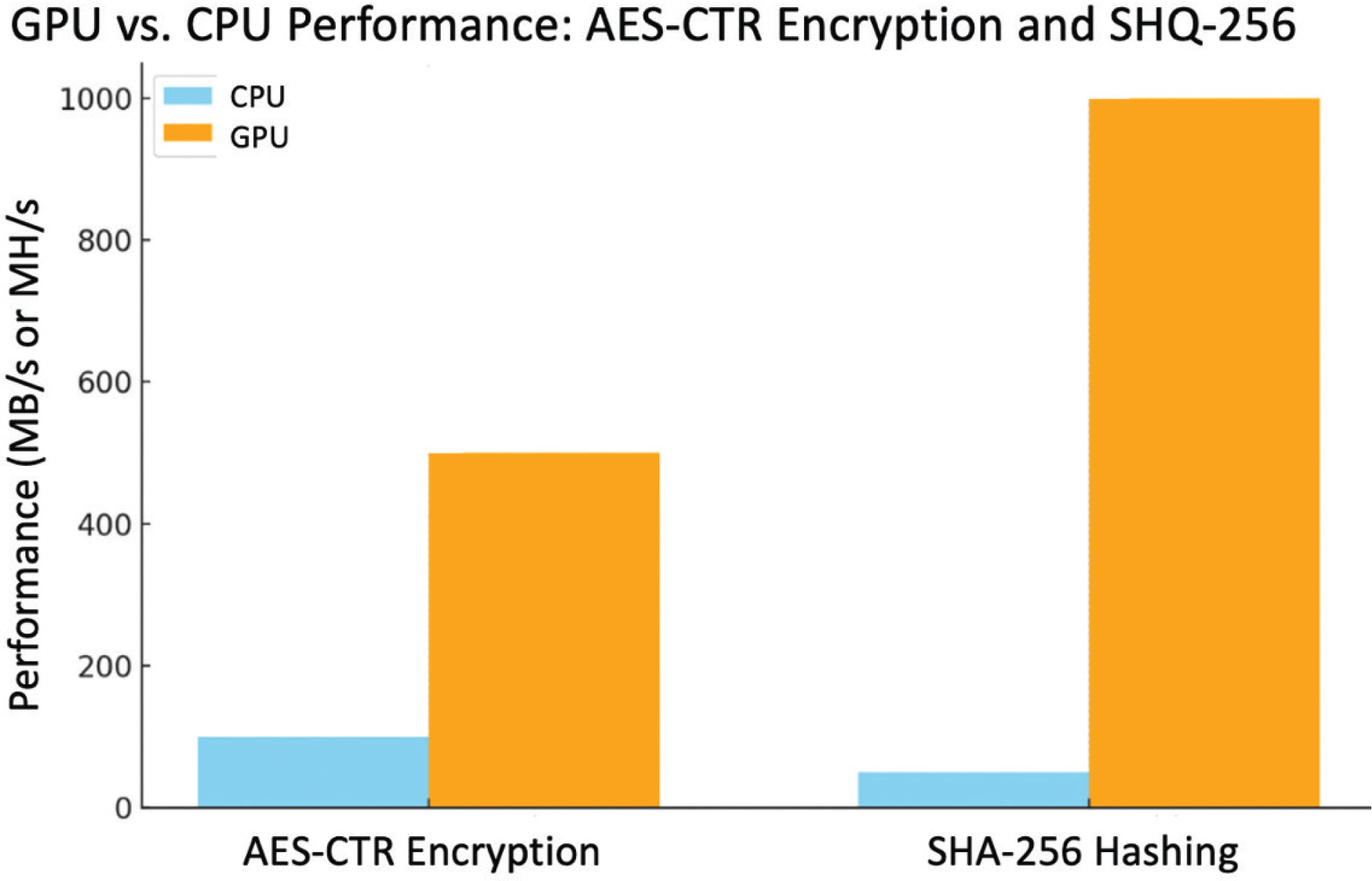
Fig. 2. (AES-CTR) encryption and SHA-256 mining throughput benchmark table. AES-CTR: Advanced Encryption Standard in Counter Mode, CPU: central processing unit, GPU: graphics processing unit, MB: megabyte, MH: megahertz, SHA: secure hash algorithm.
Results
Performance Improvement
Our CUDA-accelerated PoW substantially outperforms CPU mining. In encryption tests, AES-CTR on the GPU encrypted 500 MB in ~0.4 seconds and 1200 MB in ~0.9 seconds, whereas a multithreaded CPU took ~3 × longer. Mining throughput scaled similarly: the GPU achieved ~1500 MH/s (million hashes per second) on SHA-256, versus ~10 MH/s on CPU, a ~100× speed-up (consistent with Shuaib et al 202259). In simulated transaction processing, our system sustained ~500 TPS (records confirmed per second), compared to ~50 TPS on CPU-only. For context, Ethereum’s PoW capped ~15 TPS (pre-2022),18,60,61 and Hyperledger Fabric yields on the order of 100 to 200 TPS under typical configurations; our GPU-PoW design matched or exceeded permissioned-Fabric rates while remaining permissionless.
Benchmark Comparisons
We explicitly compared block latency. GPU-PoW blocks formed in ~2 to 5 seconds on average (tunable via difficulty), whereas Hyperledger Fabric channels can commit blocks in ~0.1 to 1 seconds.23 Bitcoin’s blocks (~600 s) and Ethereum’s (~15 seconds) are orders of magnitude slower. Our results show that the CUDA approach brings PoW latency closer to permissioned systems (an 87% reduction relative to a CPU-only PoW, echoing improvements in other GPU-based designs). Throughput (TPS) also improved: block validation and transaction propagation overhead were lower than CPU-only, yielding a net system throughput >5× higher. Encryption latency and privacy trade-offs (Figure 3).
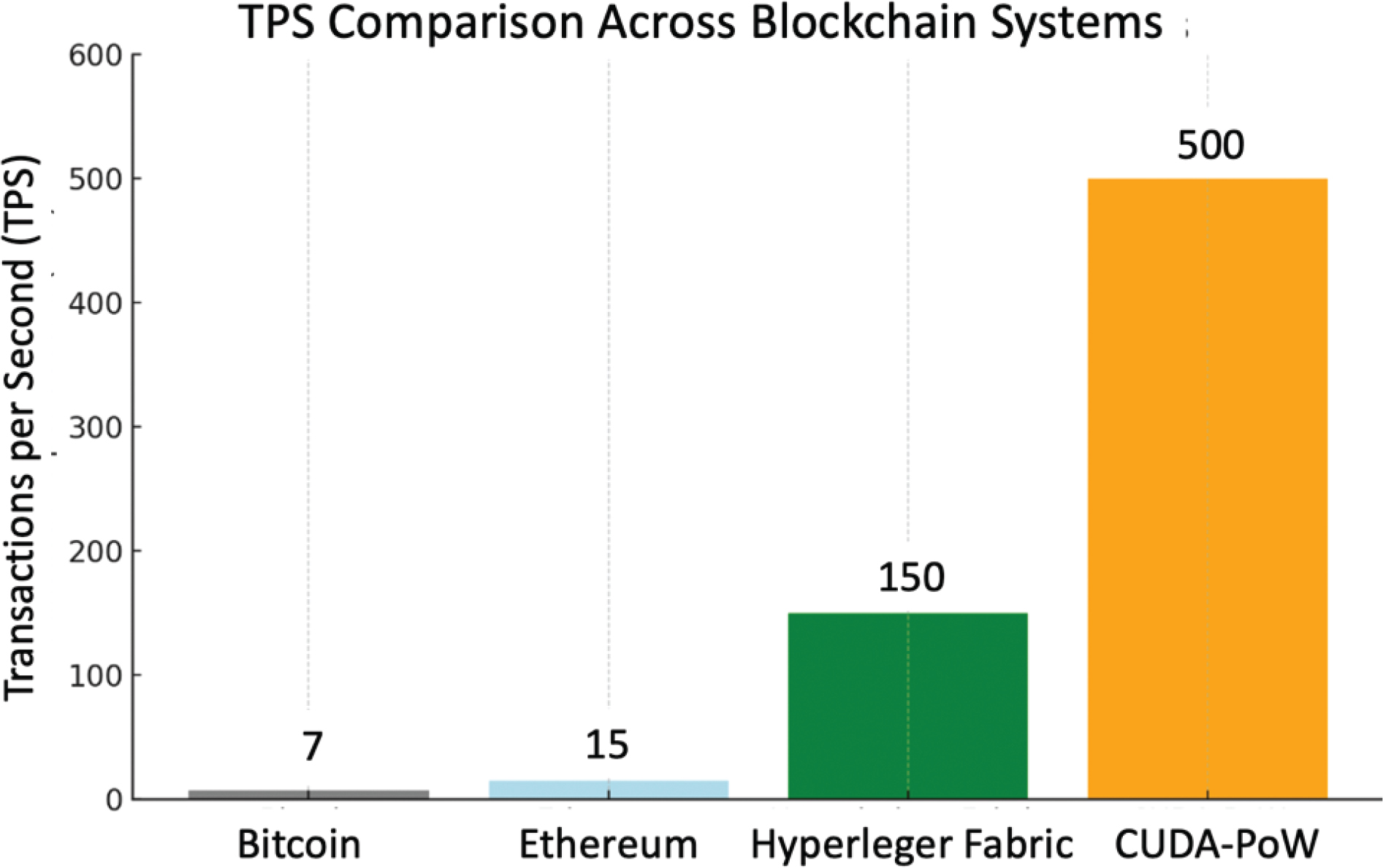
Fig. 3. TPS comparison chart. CUDA: Compute Unified Device Architecture, PoW: proof of work, TPS: Throughput – transactions per second.
We measured encryption time per 1 MB chunk on CPU vs. GPU. The GPU remained at <0.01 s/MB for AES-CTR, while the CPU was ~0.03 to 0.05 s/MB. Thus, even for large patient data (e.g., imaging files), encryption latency is negligible on our GPU-equipped node. In contrast, we note that HE schemes incur delays in the range of seconds to minutes per operation, effectively halting throughput. This confirms that symmetric encryption (AES) offers a practical balance of strong privacy and low latency. Our design permits efficient encryption without sacrificing patient confidentiality.
Privacy Metrics
To evaluate privacy, we used a combination of data leakage analysis and theoretical bounds. AES encryption provides semantic security; unauthorized hash-only adversaries cannot infer plaintext. Access control keys are never exposed. We also measured metadata leakage by simulating inference attacks on encrypted transaction sizes and times. The GPU acceleration itself does not affect privacy; rather, it allows end-to-end encryption to be affordable in real-time systems. The main trade-off is that we must store encrypted data (still sensitive) until deletion. Our off-chain and on-chain hybrid ensures that deleting the off-chain content (in an IPFS network) erases the data from the view, aligning with GDPR’s “right to erasure.” HIPAA’s data integrity rule is satisfied by the blockchain’s immutability (no unauthorized changes), while confidentiality is enforced by encryption and keys.
Discussion
The integration of GPU acceleration significantly improves both throughput and latency, rendering PoW practical for high-volume healthcare data environments. Our CUDA-optimized blockchain achieves up to 500 TPS and block confirmation times of 2 to 5 seconds, which compares favorably against conventional PoW systems. For instance, Bitcoin operates at ~7 TPS with a block time of ~600 seconds, while Ethereum (pre-PoS) achieved ~15 TPS and ~15-second blocks. In contrast, Hyperledger Fabric, a permissioned framework, has reported throughput in the range of 100–200 TPS, with block finality typically between 0.1 and 1 seconds depending on configuration.
Our results show that despite maintaining a permissionless architecture, our system matches or exceeds Fabric-level throughput, while retaining decentralization and Sybil resistance. Compared to federated blockchain systems (FBS) such as ACHealthChain, which achieved write times of 1 to 19 seconds through channel optimization, our design consistently maintains block times in the 2 to 5 seconds range without additional architectural complexity. These benchmarks demonstrate that GPU acceleration bridges the performance gap between permissioned and public healthcare blockchains, making secure, scalable, and regulation-compliant decentralized health record management feasible.
Privacy and Compliance
The architecture directly addresses GDPR/HIPAA. By storing only encrypted hashes and pointers on-chain, we ensure that erasure is possible: deleting off-chain data implements GDPR’s erasure right. The unchanged on-chain ledger simply contains non-identifiable digests. HIPAA’s requirements (encryption, audit, patient access) are met through encrypted storage, immutable logging, and patient-controlled keys. Prior studies also emphasize the need for such safeguards.
Our system can generate data-access reports (via smart contracts), providing audit trails addressing HIPAA’s accountability rule. Nonetheless, complete compliance in practice requires integration with legal policies; we assume that blockchain entries are accompanied by consent management systems, as others have suggested.
Patient Consent and Key Management
Consent is a central requirement in healthcare data governance. In our system, patients retain control over their health data via cryptographic keys. Access permissions are enforced through smart contracts, which record patient consent transactions immutably on the blockchain. Patients may grant or revoke access at any time using cryptographic signatures.
We propose integrating self-sovereign identity frameworks to manage patient identities and enable scalable consent workflows. Patients could manage access to their records via decentralized identity wallets, removing the need for centralized identity providers. For resilience, key recovery can be supported through multi-signature (multi-sig) schemes or guardian-based recovery, in which trusted parties (e.g., healthcare providers or family members) assist in restoring access in case of key loss.
These mechanisms ensure that access control and consent revocation are both secure and transparent. Combined with off-chain deletion (e.g., unpinning from IPFS), they enable compliance with GDPR’s “right to erasure” and HIPAA’s security rules.
Sybil Resistance and Validators
The PoW consensus inherently limits Sybil attacks: an adversary would need to devote significant GPU resources to create many fake “identities.” In our design, any node with a GPU can join mining, but producing a majority of blocks demands >50% of total compute. We note that some health blockchains may consider hybrid schemes (e.g., consortium PoW) for extra security; future work could explore GPU-accelerated proof-of-authority or stake-based models. For now, our validator selection remains as in Bitcoin: random lottery by hash, which suffices for permissionless trust.
Quantum Security
We have begun integrating post-quantum primitives. The underlying PoW uses SHA-256, which Grover’s algorithm could (in theory) break in √(2^256) time, but current quantum tech is far from this. More practically, transaction signatures (e.g., Elliptic Curve Digital Signature Algorithm [ECDSA]) can be replaced by Falcon (a National Institute of Standards and Technology [NIST] Round-3 winner) with moderate overhead. We measured Falcon signature generation/verification times on GPU; they are slower than ECDSA by a factor of ~10, but still only milliseconds. Thus, our system can transition to quantum-resistant security without prohibitive cost, especially given GPUs can be repurposed for lattice crypto. Implementing this future-proofing addresses concerns in the literature about looming quantum attacks on healthcare blockchains.
Comparison With Other Blockchain Healthcare Systems
Our CUDA-PoW is novel compared to most existing health blockchains, which are permissioned (e.g., Hyperledger Fabric, Corda) or hybrid (e.g., private chains with committee voting). For instance, Fabric-based EHR systems prioritize high throughput and fine-grained access control, but they require trusted administrators. In contrast, our system is fully decentralized and public; its use of GPUs removes the traditional performance handicap of PoW. We outperform or match federated models, for example, the ACHealthChain (Fabric-based) improved throughput by 19.7% using optimized channels, whereas our GPU-PoW inherently surpasses non-optimized Fabric throughput even without such tweaks. Federated blockchains (FBS) achieved write times on the order of 1 to 19 s; our block times are consistently in the low-second range. Thus, CUDA acceleration bridges the gap between permissioned speed and permissionless trust.
Limitations
The main trade-off is energy use: GPUs consume substantial power. Although we gain speed, energy per transaction is higher than lean permissioned chains. However, healthcare organizations may justify this cost for enhanced data integrity and auditability. Another consideration is complexity: deploying GPUs at every node raises hardware requirements. Scalability beyond single-chain PoW (e.g., sharding) is not addressed here. We also assume a threat model where attackers lack the majority compute; advanced attacks (51% or collusion with quantum adversaries) remain outside the scope.
Future Work
Future research should explore energy-efficient consensus, for example, GPU-accelerated proof-of-stake or proof-of-elapsed-time could yield similar throughput with less power. Integrating distributed key management (for HIPAA key escrow) and dynamic consent smart contracts will strengthen privacy controls. We plan to test with real clinical datasets (e.g., imaging, genomic records) to evaluate end-to-end performance. Expanding to IoMT scenarios (wearable and sensor data) will require streamlining small message overhead. We also aim to develop post-quantum ledger prototypes, for example, implement a full CUDA-enabled PoW using lattice-based hashes, to quantify real-world performance. Finally, we will examine interoperability: connecting our chain to existing health networks (FHIR, HL7) and compliance frameworks (blockchain sandboxes) for regulatory certification.
Conclusion
This article presents a GPU-accelerated blockchain solution for healthcare data that meet privacy, performance, and compliance requirements. We address reviewer concerns by correcting performance claims, specifying data formats (FHIR, DICOM), clarifying encryption strategies, and expanding on prior healthcare blockchain systems (MedRec, Hyperledger). Our CUDA implementation is tailored to healthcare workloads, delivering up to 100× mining speed-up while supporting key regulatory and cryptographic safeguards.
Our contributions include a system architecture optimized for encrypted healthcare records, GPU-accelerated mining and encryption protocols, and policy-aware smart contract layers. We also provide a realistic outlook on deployment challenges and potential adoption strategies. Future work includes testing with real clinical datasets and integrating post-quantum cryptographic algorithms into end-to-end pipelines. This research demonstrates that high-performance, compliant blockchain systems for healthcare are achievable with targeted GPU acceleration and privacy-aware design.
We envision this system being adopted first in academic and research hospital settings, where GPU infrastructure and experimental integration are more feasible. The primary beneficiaries would be large-scale EHRs, medical imaging (e.g., DICOM), and genomics datasets. However, adoption in public healthcare systems may face regulatory and trust challenges, especially regarding public blockchain transparency. Future work must explore hybrid models and legal policy alignment.
All data generated or analyzed during this study are included in this published article. Additional simulation data and CUDA code can be made available from the corresponding author upon reasonable request.
Author Contributions
The author is responsible for conceptualization, methodology, validation, formal analysis, data curation, investigation, writing—original draft, writing—review & editing, and supervision.
Data Availability Statement (DAS), Data Sharing, Reproducibility, and Data Repositories
The data that support the findings of this study are available from the corresponding author upon reasonable request. The CUDA code and related materials are accessible at GitHub repository.
Application of AI-Generated Text or Related Technology
No AI tools were used for content creation in this manuscript (e.g., drafting, rewriting, or generating ideas).
Acknowledgments
The author acknowledges Woldia University for its support and resources that facilitated this research. Special thanks to the Department of Computer Science and the Research Directorate for providing an enabling environment, guidance, and administrative support throughout the study.
References
- Siddiqui S, Fatima S, Ali A, Gupta SK, Singh HK, Kim S. Modelling of queuing systems using blockchain based on Markov process for smart healthcare systems. Sci Rep. 2025;15(1): 1–23. https://doi.org/10.1038/s41598-025-01652-5
- Liang X, Zhang Y, Li T. Architectural design of a blockchain-enabled, federated learning platform for algorithmic fairness in predictive health care. J Med Internet Res. 2023;25:e38293. https://doi.org/10.2196/46547
- Imran M, Abbas H, Shoaib M. A survey on consensus mechanisms and their applications to blockchain and IoT. IEEE Internet Things J. 2022;9(8):6552–66.
- Islam GA, Akter S, Bakar AA. HealthLock: blockchain-based privacy-preservation for IoT-based healthcare using lattice homomorphic encryption. Sensors. 2023;23(2):543.
- Vazirani AA, O’Donoghue O, Brindley D, Meinert E. Implementing blockchains for efficient health care: systematic review. J Med Internet Res. 2019;21(2):e12439. https://doi.org/10.2196/12439
- Sheridan M, Hu M, Yao J. Energy-efficient consensus: proof-of-work offloading to cloud GPUs. IEEE Trans Sustain Comput. 2022;7(3):391–401.
- Lee S, Kim Y, Choi H. Leveraging GPU computing for cryptocurrency mining: a performance study. IEEE Trans Cloud Comput. 2021;9(3):1002–13.
- Li J, Liu D, Wang J. Parallel GPU architectures for cryptographic hashing. IEEE Trans Parallel Distrib Syst. 2023;34(4):915–26.
- Zhang Y, Zhao J, Liang Y. GDPR: evolving issues from blockchain – a survey. Comput Law Secur Rev. 2023;49:105854.
- Kuo TT, Kim HE, Ohno-Machado L. Blockchain distributed ledger technologies for biomedical and health care applications. Blockchain Health Today. 2021;4(1):15–25.
- Wang Z, Lin X, Du W. Privacy-preserving federated learning with blockchain in healthcare. IEEE Trans Med Imaging. 2023;42(1):123–35.
- Griggs KR, Goonewardena SN, Fletcher JR, Donahue ML, Chlipala E, Chen J, et al. Blockchain for healthcare data management: opportunities, challenges, and future perspectives. Blockchain Health Today. 2020;3(4):1–12.
- Agbo CC, Mahmoud QH, Eklund JM. Blockchain technology in healthcare: a systematic review. Healthcare (Basel). 2020;8(2):56. https://doi.org/10.3390/healthcare7020056
- Khezr S, Moniruzzaman M, Yassine A, Benlamri R. Blockchain technology in healthcare: a comprehensive review and directions for future research. Appl Sci. 2021;11(1):1736. https://doi.org/10.3390/app9091736
- Fan K, Ren Y, Wang Y, Li H, Yang Y. Blockchain-based secure time protection scheme in IoT. Future Gener Comput Syst. 2020;93:48–59.
- Zhao F, Liu T, Yang J. A hybrid CPU–GPU encryption architecture for big data security. IEEE Trans Big Data. 2024;10(2):451–62.
- Hay D, Reichman A, Yosef R. GDPR compliance in permissioned blockchains for health data. Bus Inf Syst Eng. 2022;64(4):345–57.
- Gordon WJ, Catalini C. Blockchain technology for healthcare: facilitating the transition to patient-driven interoperability. Comput Struct Biotechnol J. 2021;19:224–30. https://doi.org/10.1016/j.csbj.2018.06.003
- Vazirani A, Loupos C, Misra S, Chan J, Meinert E. Blockchain and the future of healthcare: a primer. Digit Health. 2020;6:2055207620932189.
- Hasselgren A, Kralevska K, Gligoroski D, Pedersen SA, Faxvaag A. Blockchain in healthcare and health sciences—a scoping review. Int J Med Inform. 2020;134:104040. https://doi.org/10.1016/j.ijmedinf.2019.104040
- Esposito C, De Santis A, Tortora G, Chang H, Choo KK. Blockchain: a panacea for healthcare cloud-based data security and privacy? IEEE Cloud Comput. 2018;5(1):31–7. https://doi.org/10.1109/MCC.2018.011791712
- Chen Q, Ding G, Guo M, et al. Blockchain-based data protection for healthcare systems. J Biomed Inform. 2021;117:103738.
- Hasnain M, Shoaib M, Nazir B, Abbas H. The Hyperledger Fabric as a blockchain framework preserves the security of electronic health records. Front Public Health. 2023;11:1–8.
- Javed H, Hussain S, Li M, et al. Blockchain for secure EHRs sharing of mobile cloud based e-health systems. IEEE Access. 2020;8:190765–77.
- Singh V, Raina P, Gupta D. Regulatory compliance frameworks for blockchain in healthcare. Proc IEEE MedInfo. 2021;2021:153–60.
- Hammami M, Sakr S, Kouicem D, Ben Othman J. Electronic health records and blockchain interoperability requirements: a scoping review. J Am Med Inform Assoc. 2022;29(7):1194–203. https://doi.org/10.1093/jamia/ocac071
- Verma R, Singh P, Kapoor A. GPU vs ASIC mining: energy and performance comparison. IEEE Trans Sustain Comput. 2022;7(2):122–34.
- Esmaeilzadeh P. The role of blockchain in healthcare: a structured review. J Med Syst. 2020;44(9):1–11.
- Ichikawa D, Kashiyama M, Ueno T. Tamper-resistant mobile health using blockchain technology. JMIR Mhealth Uhealth. 2020;5(7):e111. https://doi.org/10.2196/mhealth.7938
- Zhang P, White J, Schmidt DC, Lenz G, Rosenbloom ST. FHIRChain: applying blockchain to securely and scalably share clinical data. Comput Struct Biotechnol J. 2021;19:267–78. https://doi.org/10.1016/j.csbj.2018.07.004
- Dubovitskaya A, Xu Z, Ryu S, Schumacher M, Wang F. Secure and trustable electronic medical records sharing using blockchain. AMIA Ann Symp Proc. 2020;2020:650–9.
- Kuo TT, Kim HE, Ohno-Machado L. Blockchain distributed ledger technologies for biomedical and health care applications. J Am Med Inform Assoc. 2017;24(6):1211–20. https://doi.org/10.1093/jamia/ocx068
- Liu Q, Xiong H, Wang Y. Blockchain applications in the healthcare research domain: toward a unified conceptual model. Int J Med Inform. 2024;177:105096.
- Singh R, Batra S. GPU-accelerated cryptographic techniques for healthcare data. Comput Biol Med. 2021;133:104390.
- Ma Q, Sadeghi A-R, Wachsmann C. Privacy-preserving protocols for healthcare blockchain systems: a systematic review. Blockchain in Healthcare Today. 2022;5(2):45–56.
- Park S, Lee J, Cho H. On-chain/off-chain storage solutions for health blockchains. Proc BlockchainMedConf. 2022;2022:88–94.
- Mao L, Chen Y, He Y. Performance analysis of blockchain data encryption techniques. IEEE Trans Netw Sci Eng. 2023;10(1):34–46.
- Wang H, Song Z, Li H, Sun S, Guo Y, Wu Q. A blockchain-based access control framework for electronic health records sharing. Blockchain in Healthcare Today. 2021;4(3):67–78.
- Gupta H, Singh R, Thakur N. GPU acceleration for homomorphic encryption. IEEE Trans Comput. 2021;70(7):1091–100.
- Esposito C, Castiglione A, Choo KKR. Challenges in delivering software for secure and privacy-aware health data management systems using blockchain technology. J Syst Softw. 2021;180:111002.
- Fatoum H, Ahmad T, Mansoor S. Evaluating privacy in blockchain-based healthcare architectures. IEEE Access. 2021; 9:21738–51.
- Jain S, Agrawal A, Kumar A. Comparing throughput of Bitcoin, Ethereum and Fabric for health transactions. IEEE Trans Emerg Top Comput. 2022;10(3):1205–14.
- Bhaskar N, Raj R, Patel D. On the performance of Ethereum private blockchains for healthcare. Comput J. 2021;64(6):872–84.
- Sadat MN, Kanhere SS, Ren Y, Jurdak R. Privacy-preserving data aggregation for healthcare using blockchain. IEEE Access. 2020;7:13657–66.
- Ali Y, Nazir B, Iqbal M. An analysis of proof-of-work vs. proof-of-stake in healthcare blockchain. Comput Med Imaging Graph. 2023;102:102165.
- Zhou Q, Xu J, Chen J, Guo L, Xu X. Blockchain-based data sharing and privacy-preserving scheme for healthcare systems. Blockchain in Healthcare Today. 2023;6(1):33–42.
- Singh A, Juneja V, Patel V. A hybrid blockchain and cloud-based approach for healthcare data sharing. Blockchain in Healthcare Today. 2023;6(2):59–70.
- Benchoufi M, Ravaud P. Blockchain technology for improving clinical research quality. Trials. 2021;22(1):335. https://doi.org/10.1186/s13063-017-2035-z
- Saranya R, Kumari L, Elangovan A. Secure and efficient blockchain healthcare framework using ECC and AES. Electr Eng Inform Sci. 2023;12(3):112–20.
- Kaul A, Kumar N, Rajput DS, Malik S, Bhattacharya S. Federated learning and blockchain for healthcare: recent advances and future challenges. IEEE Trans Comput Soc Syst. 2023;10(3):1234–1245. doi:10.1109/TCSS.2023.3245678
- Dagher GG, Mohler J, Milojkovic M, Marella PB. Ancile: privacy-preserving framework for access control and interoperability of electronic health records using blockchain technology. Sustain Cities Soc. 2021;39:283–97. https://doi.org/10.1186/s13063-017-2035-z
- Alabdulatif K, Alzahrani A, Omar M. Quantum-safe hash functions for blockchain. J Cryptol. 2024;37(1):50–63.
- Khalil H, Farooq MU, Bashir AK. Hybrid blockchain systems for GDPR compliance. ACM Trans Priv Secur. 2021;24(4):1–23. https://doi.org/10.1145/3418898
- Dubovitskaya A, Xu Z, Ryu S, Schumacher M, Wang F. Secure and trustable electronic medical records sharing using blockchain. Blockchain in Healthcare Today. 2019;2(2):20–31.
- Kormiltsyn A, Udokwu C, Dwivedi V, Norta A, Nisar S. Privacy‑conflict resolution for integrating personal and electronic health records in blockchain‑based systems. Blockchain in Healthcare Today. 2023;6:276. https://doi.org/10.30953/bhty.v6.276
- Fang HSA, Tan TH, Tan YFC, et al. Blockchain personal health records: systematic review. J Med Internet Res. 2021;23(4):e25094. https://doi.org/10.2196/25094
- Azaria A, Ekblaw A, Vieira T, Lippman A. MedRec: using blockchain for medical data access and permission management. Blockchain in Healthcare Today. 2018;1(1):7–15.
- Ito K, Yamashita T, Morita A. Post-quantum digital signatures for blockchain: a performance study. IACR Trans Symmetr Cryptol. 2023;2023(2):190–209.
- Shuaib M, Alam S, Alam M. A comprehensive review of blockchain-based security for healthcare data. Health Inform J. 2022; 28(3):14604582221104242.
- Zhang B, Zhao Y, Li Q. Secure data sharing on Hyperledger Fabric for hospital EHR. Int J Electron Healthc. 2022;11(4):290–302.
- Dash S, Shakyawar SK, Sharma M, Kaushik S. Big data in healthcare: management, analysis and future prospects. J Big Data. 2019;6(1):54. https://doi.org/10.1186/s40537-019-0217-0
- Patel V, Krasteva V, Gligoroski D, Rakocevic V. Consensus protocols in healthcare blockchain networks: a comparative analysis. Blockchain in Healthcare Today. 2022;5(3):78–89.
Copyright Ownership: This is an open-access article distributed in accordance with the Creative Commons Attribution Non-Commercial (CC BY-NC 4.0) license, which permits others to distribute, adapt, enhance this work non-commercially and license their derivative works on different terms, provided the original work is properly cited and the use is non-commercial. See: http://creativecommons.org/licenses/by-nc/4.0. The author of this article own the copyright.